


Gemstone investment due diligence is the process of verifying a stone’s quality, authenticity, provenance, and certification before committing capital. Skipping any step exposes you to misrepresented treatments, inflated valuations, and stones that cannot be resold at fair value. Labs like GRS, Gübelin, and SSEF set the global standard for independent verification, while market benchmarks from sources like The Sapphire Bank give investors real pricing context. This guide walks you through every critical checkpoint, from reading a lab report to planning your exit.
What are the key certification standards for gemstone due diligence?
Certification is the single most verifiable element of gemstone investment due diligence. Without an independent lab report, you are relying entirely on a seller’s word. That is not a position any serious investor should accept.
Gemstones priced above $5,000 require certification from GRS, Gübelin, or SSEF to maintain resale liquidity. For stones valued above $30,000, dual certification from two of these labs is the accepted standard. The logic is straightforward: a second independent opinion removes any ambiguity about treatment status or origin, which are the two factors that move price the most.
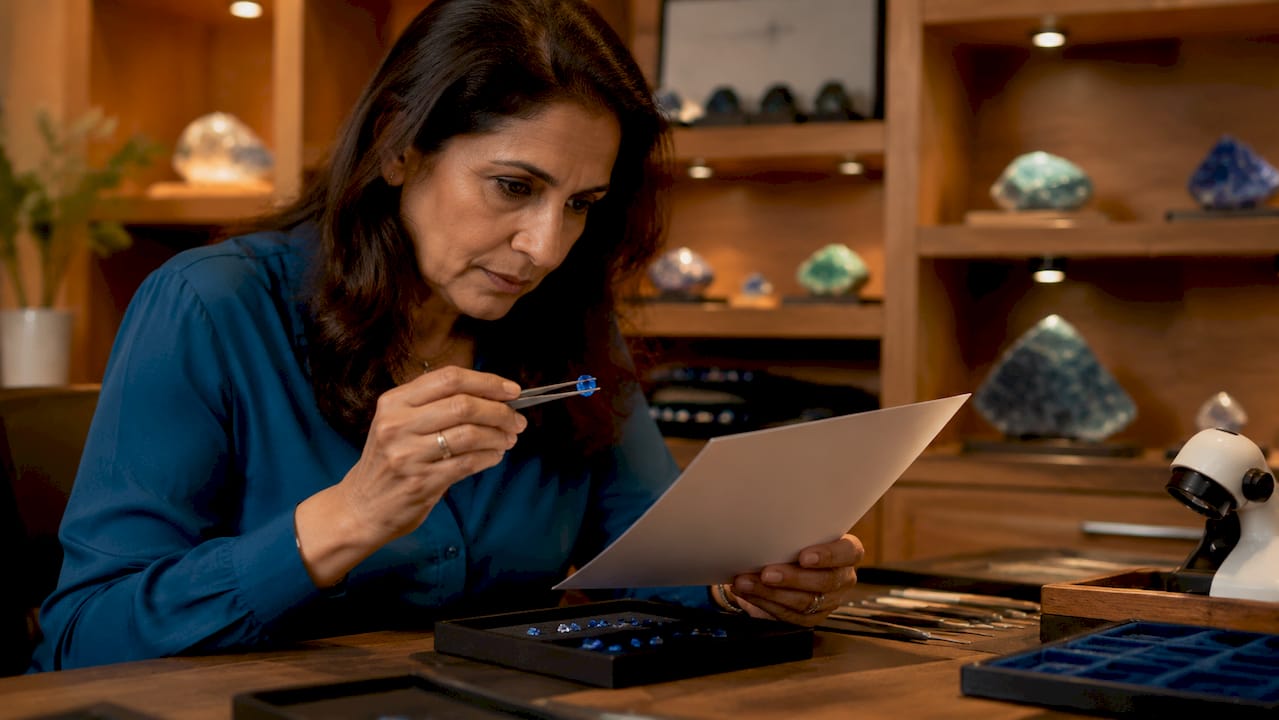
Seller-issued documents, sometimes called house certificates, carry negligible value in secondary markets. Independent lab reports, by contrast, can support prices 40–100% higher than equivalent stones sold without them. That gap alone justifies the cost of certification on any serious purchase.
Here is what a credible lab report tells you:
- Treatment status: Whether a stone is heated or unheated. Unheated rubies and sapphires command significant premiums.
- Geographic origin: Burma, Mozambique, and Ceylon are the three origins that most directly affect price ceilings and buyer demand.
- Color designation: Labs like GRS use proprietary descriptors such as “Pigeon’s Blood” for rubies and “Royal Blue” for sapphires. These terms appear on the certificate and directly influence auction pricing.
- Unique identifiers: Weight, dimensions, and microscopic inclusions that confirm the stone matches its report.
Pro Tip: When reviewing a certificate, check the report number against the issuing lab’s online verification portal. GRS, Gübelin, and SSEF all offer this. A certificate that cannot be verified online should be treated as suspect.
Reading the language on a report matters as much as having one. Phrases like “indications of heating” or “clarity enhancement” are not neutral. They signal treatments that reduce value. Train yourself to read these distinctions before you buy.
How does gemstone durability affect investment and setting choices?
Durability determines whether a stone holds its physical condition over decades of ownership. For investors, a chipped or scratched stone loses both aesthetic and resale value. Understanding the Mohs hardness scale is the starting point.
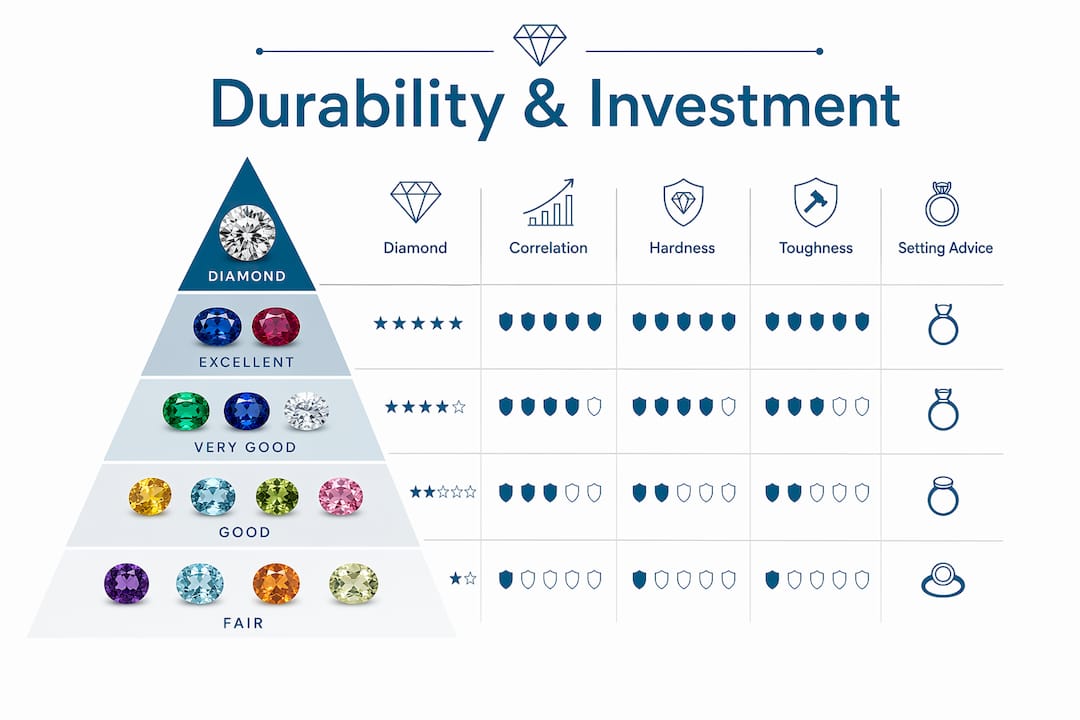
The Mohs scale runs from 1 to 10, but it is not linear. Diamond hardness is roughly four times greater than corundum at 9, even though they sit one step apart on the scale. That distinction matters when comparing investment stones.
| Gemstone | Mohs Hardness | Investment Suitability |
|---|---|---|
| Diamond | 10 | Highest durability for daily wear |
| Ruby / Sapphire | 9 | Excellent for rings and active wear |
| Spinel | 8 | Strong choice for pendants and earrings |
| Jade | 6–7 | High toughness despite moderate hardness |
Hardness measures scratch resistance. Toughness measures resistance to fracture. Jade demonstrates high toughness despite its moderate Mohs rating, which is why it has held investment value across centuries in Asian markets. These are two different properties, and confusing them leads to poor setting and storage decisions.
Prong settings can expose stones to impact damage in active wear scenarios. A bezel setting, which wraps the girdle of the stone in metal, offers significantly better protection. For investment-grade rubies and sapphires worn regularly, bezel or channel settings reduce the risk of chipping at the girdle edge.
Pro Tip: Store investment stones individually in fabric-lined compartments. Diamonds will scratch sapphires if stored together, regardless of how carefully you handle them.
Durability also affects how you should plan for long-term preservation. A stone kept in a secure setting, stored properly, and cleaned with appropriate methods will grade better at resale than one showing surface wear.
How should investors research provenance and market data?
Provenance research is the part of gemstone due diligence most investors underestimate. Origin is not just a geographic label. It is a price multiplier, a liquidity signal, and a geopolitical risk factor all at once.
Burmese rubies versus Mozambique rubies illustrate this clearly. Both produce fine stones, but Burmese origin commands a premium rooted in centuries of market prestige and scarcity. Mozambique rubies have gained significant acceptance since the 2000s, but they still trade at a discount to comparable Burmese material. Your certificate’s origin statement directly affects your price ceiling.
Follow these steps to conduct thorough provenance and market research:
- Confirm origin on the certificate. The lab report must explicitly state the geographic origin. “Origin not determined” is a red flag for investment-grade purchases.
- Check for sanctions exposure. U.S. sanctions have historically restricted trade in Burmese rubies under the Tom Lantos Block Burmese JADE Act. Verify current regulatory status before purchasing Burmese-origin stones.
- Review recent auction results. Christie’s, Sotheby’s, and Bonhams publish realized prices for colored stones. Cross-reference the origin, weight, and treatment status of comparable lots to benchmark your target stone.
- Consult market indices. The Sapphire Bank publishes structured market data on colored stone performance. Investment-grade sapphires with certified origin have shown annual appreciation of 8–12% over the past five years. That figure applies specifically to unheated, 2-plus carat stones with documented provenance.
- Assess ethical sourcing. Sustainable supplier vetting is increasingly relevant to institutional buyers and auction houses. Stones with documented chain of custody from responsible mines attract a broader buyer pool at resale.
Beyond price benchmarking, provenance documentation supports stronger negotiating positions. A stone with a complete paper trail, from mine to current owner, commands more confidence from serious buyers than one with gaps in its history.
How to plan exit strategies and assess gem market liquidity
Gem market liquidity is the measure of how quickly and at what price you can convert a stone back to cash. The honest answer is that gemstone markets are highly illiquid. High-end rubies and sapphires cannot be sold quickly at fair market value. Realistic exit timelines run from several months to several years.
This is not a flaw in the asset class. It is a structural characteristic you must plan around before you buy.
“Investors must view gemstones as long-term assets. The market requires patience and strategic exit planning due to its inherent illiquidity.” — The Sapphire Bank
Key liquidity considerations before any purchase:
- Holding period: Plan for 3–15 years to capture meaningful appreciation. Stones sold under time pressure almost always sell below fair market value.
- Stone selection: Rubies and sapphires from Burma and Ceylon with top-tier certification sell faster than unusual or heavily included stones. Liquidity favors the mainstream.
- Market concentration risk: The colored stone market is thin at the top. A supply shock from a single mine or a shift in collector taste can move prices significantly. Diversifying across stone types and origins reduces this exposure.
- Exit channel: Auction houses offer the widest buyer pool but charge seller’s premiums of 10–20%. Private treaty sales through trusted dealers preserve more margin but require a network. Know your exit channel before you enter the position.
- Appraisal currency: Machine learning models assist with price estimation, but human expert oversight remains necessary to account for origin prestige, color nuance, and current market sentiment. Get a fresh USPAP-compliant appraisal before listing any stone for sale.
The investors who lose money in gemstones are almost always the ones who treated them like equities. They bought at retail, expected quick appreciation, and sold under pressure. The ones who profit treat each stone as a multi-year position with a defined exit thesis.
Key takeaways
Effective gemstone investment due diligence requires independent certification, provenance verification, durability assessment, and a realistic liquidity plan before any purchase.
| Point | Details |
|---|---|
| Certification is non-negotiable | Stones above $5,000 need GRS, Gübelin, or SSEF reports; above $30,000 requires dual certification. |
| Origin drives price premiums | Burma, Mozambique, and Ceylon origins directly affect value ceilings and secondary market demand. |
| Durability affects long-term value | Setting choice and storage practices preserve physical condition and protect resale grades. |
| Liquidity requires long horizons | Plan for 3–15 year holding periods; gemstone markets cannot support quick exits at fair value. |
| Human appraisal remains essential | AI tools assist with pricing but cannot replace expert judgment on qualitative factors like color and origin prestige. |
What i’ve learned after years of watching investors get this wrong
The most common mistake I see is investors who buy on beauty and certify later. They fall in love with a stone at a trade show, pay a premium, and then discover the seller’s in-house document means nothing to any serious buyer. By the time they commission a GRS or Gübelin report, they have already overpaid for a stone that may not pass origin verification at the level they assumed.
The second mistake is conflating hardness with durability. I have watched collectors store a ruby and a diamond together in the same pouch, assuming both are “hard stones.” Diamonds will scratch the girdle of a ruby over time. That kind of surface damage is not always visible to the naked eye, but it shows up under magnification during a pre-sale appraisal and it chips the price.
What actually works is treating every purchase like a small acquisition. You would not buy a business without reviewing its financials. You should not buy a $15,000 sapphire without reviewing its GRS report, checking the certificate number online, benchmarking the price against recent Christie’s results, and confirming the origin statement matches the premium you are paying.
The investors I have seen do well in this space share one trait: patience. They buy right, hold long, and sell through the right channel. They do not chase trends. They do not panic when the market goes quiet. They understand that a certified, unheated Burmese ruby with clean provenance will find a buyer. It just may take eighteen months, not eighteen days.
If you are working with a concierge gemologist or a USPAP-certified appraiser, use them at the front end of every transaction, not just when something goes wrong.
— Jake
How Stlgems supports your gemstone investment process
Stlgems brings USPAP-compliant appraisal expertise and independent gemological testing to every stage of the investment process.
Whether you are verifying a GRS certificate before a six-figure purchase or building a gemstone investment process from scratch, Stlgems provides the independent, personalized guidance that protects your capital. The team handles certification verification, provenance research, and pre-purchase assessments for individual collectors and industry professionals alike. For investors who want a trusted second opinion before committing, Stlgems’ concierge gemologist services offer exactly that. Reach out before you buy, not after.
FAQ
What certifications are required for investment-grade gemstones?
Stones priced above $5,000 require a report from GRS, Gübelin, or SSEF. Stones above $30,000 warrant dual certification from two independent labs.
How does gemstone origin affect resale value?
Origin directly sets price ceilings. Burmese rubies and Ceylon sapphires command premiums over comparable stones from other sources due to historical prestige and documented scarcity.
What is gem market liquidity and why does it matter?
Gem market liquidity refers to how quickly a stone can be sold at fair market value. Colored stones are highly illiquid, requiring months to years for a proper exit at full price.
How do i verify a gemstone certificate is authentic?
Check the report number on the issuing lab’s official online verification portal. GRS, Gübelin, and SSEF all provide this service. Any certificate that cannot be verified online should be treated as unreliable.
Should i get a new appraisal before selling an investment stone?
Yes. Market values shift over time, and a current USPAP-compliant appraisal reflects today’s pricing. Human appraisers also account for qualitative factors that automated pricing tools regularly miss.